Flagship Initiative #1

Pact Monitoring Toolkit

Rather than launching an entirely new monitoring mechanism, this proposed new set of tools aspires to pull together existing indicators and other monitoring methodologies (e.g., for the Sustainable Development Goals) across the United Nations and broader multilateral system, as well as in research, private sector, and civil society institutions worldwide. If critical modeling or data gaps are identified (e.g., through a comprehensive mapping exercise), the Pact Monitoring Toolkit offers a ready and recognized venue or access point for new, vetted tools or measures to fill such lacunae—including searchable, online Pact Monitoring Portal and tailor-made logframe tracking tools.

Pact Innovation Plan
Comprehensive
Mapping
Impact Coalition
Monitoring Tools
Pact Monitoring
Portal
Logframe Tool

A Smarter Monitoring Approach

Pact Monitoring, Including a Logical Framework, to Enhance Accountability and Performance

While a formal review of the Pact for the Future is not due until September 2028, developing a logical framework and other monitoring tools now offers key benefits for Member States, the UN, and civil society – forming the foundation of the proposed Pact Monitoring Toolkit and enabling the ability to:

  1. Pool existing monitoring capabilities for measuring progress toward Pact implementation, while seeking to fill gaps.
  2. Collect data and analyze multiple, parallel President of the General Assembly supervised intergovernmental efforts for driving implementation on the Pact for the Future’s 56 Actions and associated Sub-Actions.
  3. Identify implementation gaps early, while highlighting policies and programs that are most successful in advancing progress.
  4. Help channel, coordinate, and facilitate the multistakeholder ImPact Coalitions initiated at the 2024 UN Civil Society Conference in data collection and wider monitoring efforts.
  5. Demonstrate, through independent, authoritative, and user-friendly monitoring tools, tangible progress in Pact for the Future implementation, coordination, and information-sharing between Member States, the UN system, and partners across civil society and the private sector.

Tracking Progress, Action by Action

The Full Logical Framework, as featured in  Global Governance Innovation Report 2026 (section two), initially highlights 24 key Actions from the Pact for the Future, each supported by a “mini logframe” that links global challenges to measurable outcomes. These include official indicators and baseline data where available, and break down each Sub-Action into clear, trackable “Sub-Action Initiatives.” For newer or less-defined Sub-Actions, the toolkit recommends SMART (Specific, Measurable, Attainable, Relevant, and Time-bound) criteria for proxy indicators and associated, credible, and relatively recent baseline data examples to fill critical Pact implementation monitoring gaps.

FAQ Accordion

Major Takeaways from Year Two,
Planning for Years Three and Four

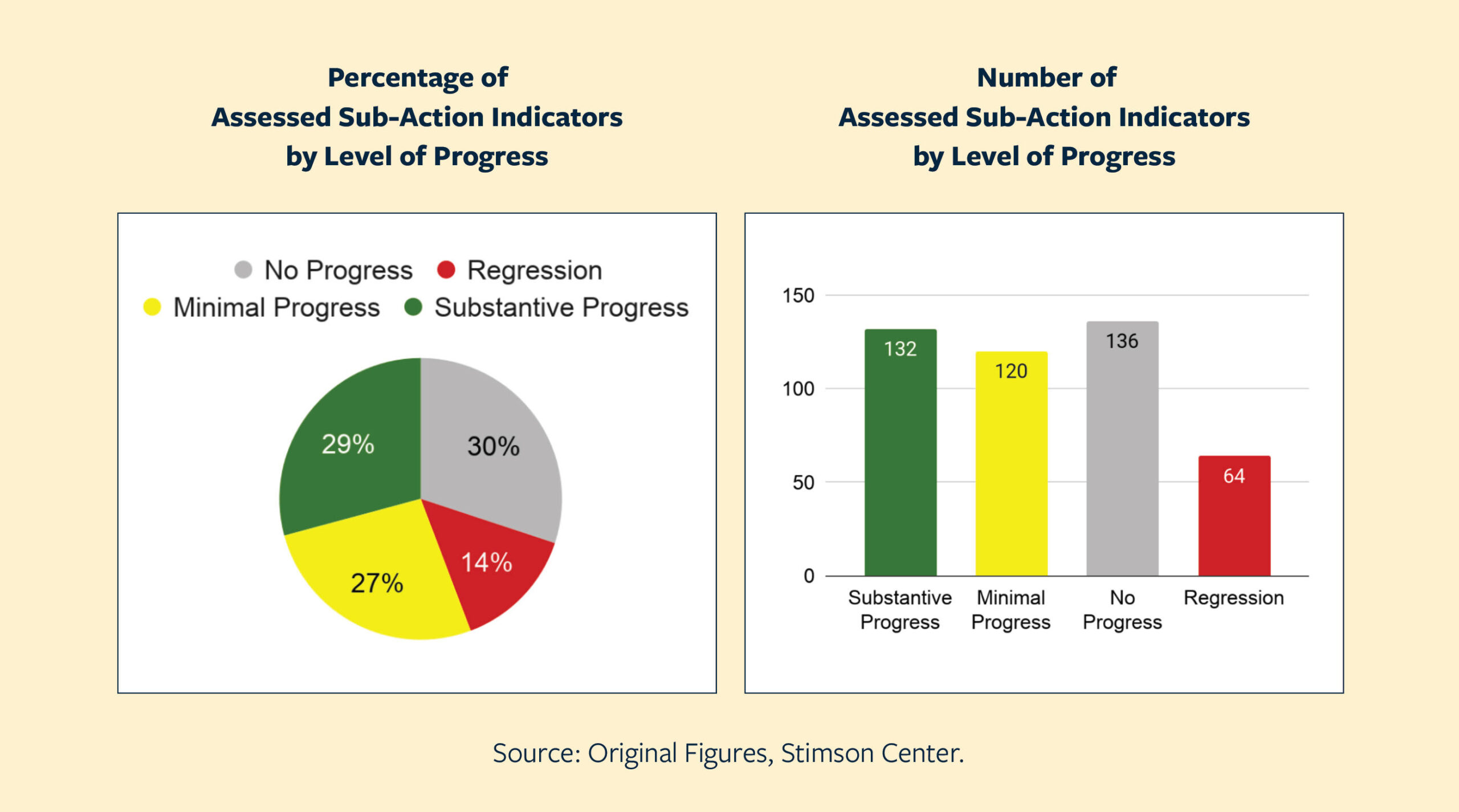
As expected in Year Two, assessed Sub-Actions saw more implementation progress compared to Year One. The below figures 2.1 and 2.2 show that 252 of 452 Sub-Action indicators (based on 40 out of 56 total Actions), or 56%, demonstrate some level of advance—29% with substantive progress and 27% with minimal progress—while 30% indicate no progress. Regrettably, 14% of Sub-Action indicators reveal regression. While 80% of Pact implementation was mandated to Member States, 20% was mandated to the UN system to be tracked by the Secretary-General’s office. According to the Executive Office of the Secretary-General, 53.2% of UN-mandated Sub-Action “milestones” have been met.186 Notable progress was made in 2026 through the Fourth International Conference on Financing for Development (FfD4), which helped to sustain momentum on international financial architecture reforms (Pact Actions 47-52); the Global Dialogue on AI governance and appointment of 40 members to the new Independent International Scientific Panel on AI (Action 30) have shown progress on AI governance globally; the Beyond GDP final report and indicator dashboard created by the High-Level Expert Group on Beyond GDP pushed forward the Action 53 agenda; and the Secretary-General’s report on rising military expenditure impact on sustainable development played a vital role for Action 13 and contributed to analysis relevant to Chapter 2 (Actions 13-27). Noteworthy progress on the digital divide in rural-urban internet use (Action 27) saw rural access increase substantially between 2024 and 2025 (from 48% to 58%), while urban access increased only slightly (83% to 85%) in the same period.
Key Takeaway Dashboard
Considered thematically, while there has been progress in some areas, the regress in other areas is telling: The data shows regress in 12% of indicators for Chapter 1 (Sustainable development and financing for development), almost 7% of Chapter 3 (Science, technology and innovation and digital cooperation), and 10% of Chapter 4 (Youth and future generations), which compare favorably with regress on 20% of Chapter 2 (International peace and security) and 17% of Chapter 5 (Transforming global governance). The major areas of concern (with zero progress or regression) are financing for development through ODA, as well as persistent political deadlocks on key areas of peace and security architecture reform (as elaborated in GGIR’26 section three). Figures 2.1 and 2.2 show that, despite waning multilateral cooperation, elements of the Pact demonstrate durable and growing areas of collaboration across a range of global governance issues, with two years to go until the September 2028 high-level review of progress.
Further steep funding cuts are anticipated and have already harmed Pact implementation across the board, as many countries pull back from foreign aid and international organization financing. In short, the UN remains on the verge of financial collapse, with roughly $1.57 billion in outstanding UN Secretariat regular budget dues at the end of 2025 and the 2026 UN budget cutting some 2,900 posts.188 The General Assembly-approved $5.38 billion budget for UN peacekeeping operations in 2025-26 is a sharp decline from $6.1 billion (for 2023-24) and $5.6 billion (for 2024-25), a trend expected to continue.189 The SG’s revised 2026 overall budget specifically reduced OHCHR’s budget by 15.2%, from $420.1 million to $377.7 million, raising serious concerns about the UN’s ability to fulfil its human rights mandate.
The Pact responds to critics of the United Nations and other multilateral institutions by demonstrating two key points: first, that broad international consensus can still be reached on urgent reforms to make the global governance system fit for the future; and second, that Summit of the Future implementation efforts are yielding tangible and, in some instances, significant results (as elaborated in section four of this report). While the geopolitical landscape has changed, the Pact remains a framework that retains both political and normative weight. As an agreement reached by Member States, it serves as a critical reference point for sustaining momentum and holding stakeholders accountable for advancing its commitments. The Pact serves as a proxy for governments and non-state actors seeking to reinvest in multilateral approaches to global problemsolving. Importantly, the concrete Actions tracked in this report do not depend on expanding bureaucracy or significantly increasing financial burdens, aligning with ongoing efforts to modernize the UN system and increase its efficiency. These efforts are reinforced by the Secretary-General’s UN80 Initiative, which is working to update UN structures, priorities, and operations for the 21st century. Together, the Pact for the Future and the UN80 Initiative are mutually reinforcing: the former sets out a shared vision and agenda, while the latter provides an operational pathway to deliver a more agile, cost-effective, and impactful multilateral system.
Pact in Action

Pact in Action

(March 19, 2026)
Pact Innovation Plan (2nd Edition) Luncheon Discussion
Co-hosted by the Global Governance Innovation Network, Mission of Germany, Mission of Namibia, Mission of India, Mission of Zambia, Mission of Singapore, Mission of the United Kingdom, Mission of Croatia, Mission of Portugal, Liechtenstein Institute on Self-Determination, and Mission of Brazil.
(March 18, 2026)
Monitoring Global Governance Multilateral Agreements
Co-hosted by the Global Governance Innovation Network, The New School Graduate Programs in International Affairs, and United Nations Academic Impact.
(February 24-April 8, 2026)
G20 and GG Innovation E-Consultation
Co-organized by the Global Governance Innovation Network and several T20 partners.
(November 24-25, 2025 )
Pact Innovation Forum Pocantico Retreat: Planning for 2026
Co-hosted by the Global Governance Innovation Network, United Nations University Centre for Policy Research, Rockefeller Brothers Foundation, Global Challenges Foundation, and the Stimson Center.
(September 24, 2025)
UNGA@80 Pact Innovation Forum High-Level Breakfast Dialogue
Co-sponsored by the Global Governance Innovation Network, Baha'i International Community, Plataforma CIPÓ, Savannah Centre for Diplomacy, Democracy, and Development, and the Stimson Center.
(July 10, 2025)
Informal Ambassadorial Level Roundtable on a Pact Innovation Forum
Co-sponsored by the Permanent Missions of Brazil, Costa Rica, Croatia, European Union, Germany, India, Jamaica, Japan, Namibia, Netherlands, Nigeria, Portugal, Singapore, South Africa, Switzerland, United Kingdom, Zambia.
(May 19, 2025)
Informal Interactive Dialogue 2: The Pact for the Future – Monitoring and Evaluation | General Assembly, 79th session
Hosted by the United Nations President of the General Assembly Summary.
(March 20 - April 30, 2025)
Pact Innovation E-Consultation
Co-moderated by the Global Governance Innovation Network, Coalition for the UN We Need, Project Starling, Oxfam International, Pathfinders (NYU CIC), Plataforma CIPÓ, Baha'i International Community, Academic Council on the UN System, Institute for Economics and Peace, UN University Center for Policy Research, and the Stimson Center.
(February 27, 2025)
Pact Innovation Plan Informal Roundtable
Co-sponsored by sixteen UN Missions, including the Permanent Missions of Australia, Brazil, Croatia, Germany, Jamaica, Japan, Morocco, Namibia, Netherlands, Nigeria, Portugal, Singapore, South Africa, Switzerland, United Kingdom, and Zambia to the United Nations, and the Global Governance Innovation Network.
(November 24-26, 2024)
Summit of the Future Follow-Through Retreat at the Pocantico Center
Co-hosted by the Global Governance Innovation Network, Rockefeller Brothers Foundation, Global Challenges Foundation, and the Stimson Center
(September 26, 2024)
Taking the Summit of the Future Agenda Forward: UNGA Roundtable on Facilitating Implementation through Dialogue, Research & Monitoring
Co-sponsored by the Global Governance Innovation Network, Savannah Center for Diplomacy, Democracy and Development, Plataforma CIPÓ, Global Challenges Foundation, Kingdom of the Netherlands, and the Stimson Center
Scroll to Top