


Flagship Initiative #2
Pact Innovation Plan
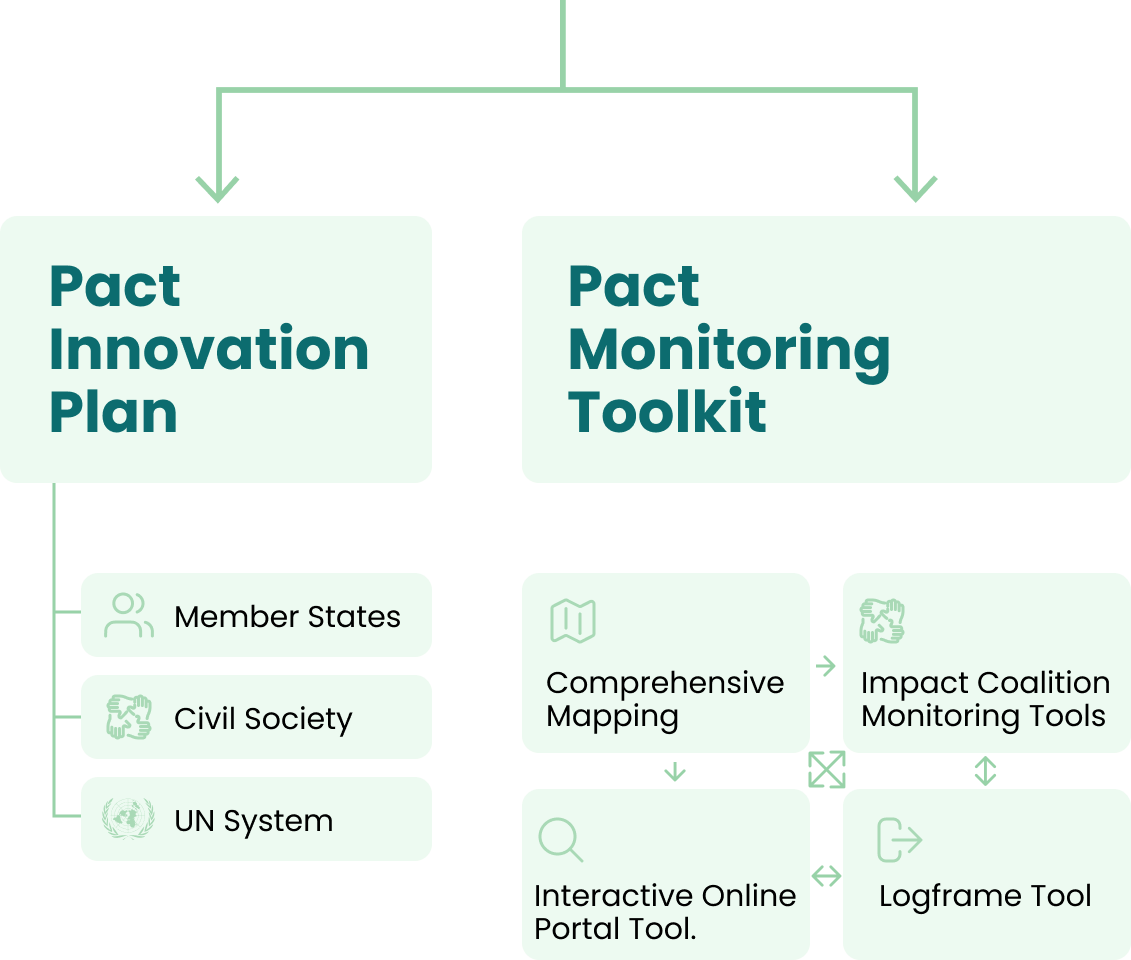
With a focus on innovation and preserving the integrity of the Pact for the Future as a whole, this new dynamic, research-driven, and catalytic instrument, developed through wide multistakeholder consultations, aims to provide Member States, the UN Secretariat and agencies, and civil society (including more than a dozen, diverse, and civil society-led ImPact Coalitions) a comprehensive analysis of relevant past experiences and a range of creative, forward-looking options and milestones to facilitate Pact implementation and follow-through.



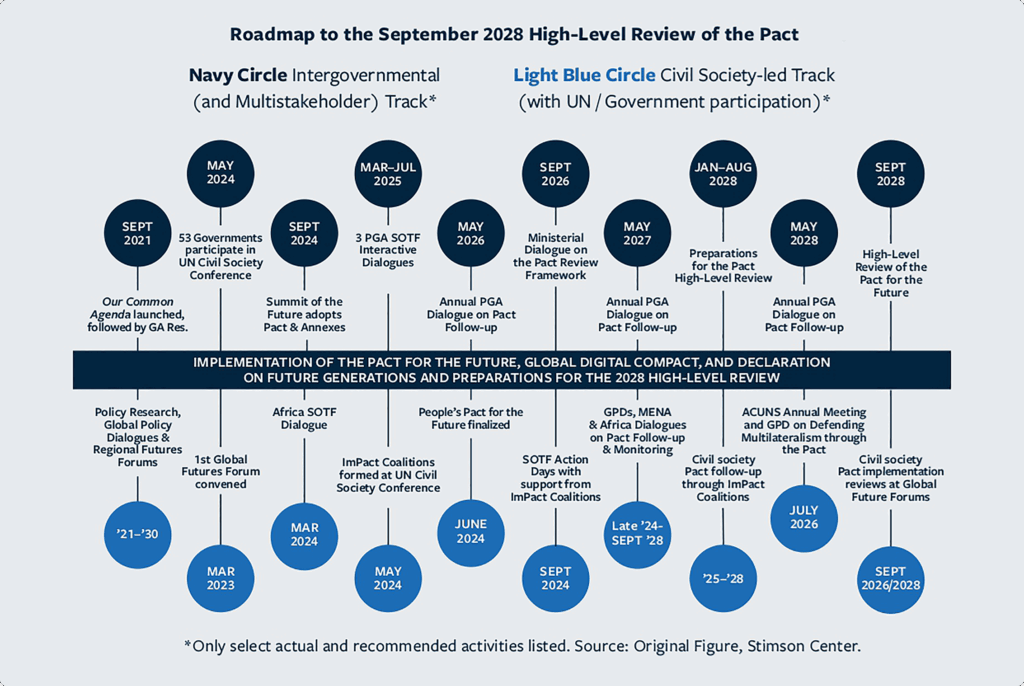
The Pact Calendar of Milestones and Events
Click the blue button on the right to view the other calendars.
- UNGA Pact Follow-Up Timeline
- UNGA 80th Session Intergovernmental Negotiating Tracks
- UN Secretary-General Working Groups for Pact Implementation
- Illustrative Mapping of Wider Intergovernmental Fora for Pact Follow-up
- Illustrative Examples of Civil-Society led Moments for Pact Follow-up
- ImPact Coalitions – status update
- Sustainable Development and Financing for Development
- International Peace and Security
- Science, Technology and Innovation and Digital Cooperation
- Youth and Future Generations
- Transforming Global Governance
In addition to the major milestones listed in this figure, two groups of intergovernmental and UN associated processes are worth showcasing as the main ways to drive input into the milestones identified and maintain momentum between key events. First are the twelve Intergovernmental Negotiating Tracks overseen by the President of the General Assembly, and second are the six Working Groups and two Task Teams overseen by the Secretary-General and his principals-led Steering Committee.
| Intergovernmental Process | Co-Facilitators (Permanent Representatives of) | Relevant Resolution(s) | |
|---|---|---|---|
| 1. | Co-Facilitators to continue to lead the intergovernmental process, which will include preparatory meetings, resulting in an intergovernmental agreed outcome document for adoption at the high-level meeting of the General Assembly on the overall review of the implementation of the outcomes of the World Summit on Information Society | H.E. Mr. Ekitela Lokaale, (Republic of Kenya) H.E. Ms. Suela Janina, (Republic of Albania) | General Assembly resolution 79/277 |
| 2. | Co-Chairs of the Intergovernmental Negotiations (IGN) on the question of equitable representation on and increase in the membership of the Security Council and other matters related to the Council during the 80th session | H.E. Mr. Tareq M. A. M. Albanai, (State of Kuwait) H.E. Ms. Lise Gregoire-van Haaren, (Kingdom of the Netherlands) | General Assembly decision 79/570 of 25 August 2025 |
| 3. | Co-Chairs of the first Global Dialogue on Artificial Intelligence Governance, to be held back-to-back in the margins of the International Telecommunication Union Artificial Intelligence for Good Global Summit in Geneva in 2026, to identify the main topics of the Dialogue and to draft a Co-Chairs' summary of the Dialogue | H.E. Ms. Egriselda López, (El Salvador ) H.E. Mr. Rein Tammsaar, (Estonia) | General Assembly resolution 79/325 |
| 4. | Co-Chairs of the Working Group on the Strengthening and Revitalizing of the Work of the General Assembly during the 80th session | H.E. Mr. Cornel Feruță, (Romania) H.E. Ms. Mutryce Agatha Williams,(Saint Kitts and Nevis) | General Assembly resolution 79/327 |
| 5. | Co-facilitators to lead the intergovernmental negotiations on a concise and action-oriented political declaration to renew commitment and accelerate the implementation of the New Urban Agenda | H.E. Mr. Krzysztof Maria Szczerski, (Poland) H.E. Mrs. Agnes Mary Chimbiri Molande, (Republic of Malawi) | General Assembly resolution 79/214 of 19 December 2024 |
| 6. | Co-chairs of the Open-ended Informal Consultative Process on Oceans and the Law of the Sea | H.E. Mr. Milan J. N. Meetarbhan, (Mauritius) H.E. Ms. Anna Jóhannsdóttir, (Iceland) | General Assembly resolutions 54/33 and General Assembly resolutions 78/69 |
| 7. | Co-facilitators to conduct intergovernmental negotiations on a concise, action-oriented and intergovernmentally negotiated declaration agreed by consensus on sea level rise | H.E. Mr. James Martin Larsen, (Australia) H.E. Ms. Tania Serafim Yvonne Romualdo, (Cabo Verde) | Sea level rise |
| 8. | Co-facilitators to lead the intergovernmental negotiations to decide the scope and modalities of the high-level meeting on improving global road safety in 2026 in New York | H.E. Mrs. Aida Kasymalieva, (Kyrgyz Republic) H.E. Mr. Peter Hulényi, (Slovak Republic) | General Assembly resolution 76/294 |
| 9. | Co-facilitators of the review of the arrangements contained in the General Assembly resolution 78/285 "Review of the implementation of General Assembly resolution 75/290 A on the strengthening of the Economic and Social Council and resolution 75/290 B on the high-level political forum on sustainable development and the follow-up and review of the 2030 Agenda for Sustainable Development at the global level" | H.E. Mr. François Jackman, (Barbados) H.E. Ms. Natasha Meli, (Malta) | General Assembly resolution 78/285 "Review of the implementation of General Assembly resolution 75/290 A on the strengthening of the Economic and Social Council and resolution 75/290 B on the high-level political forum on sustainable development and the follow-up and review of the 2030 Agenda for Sustainable Development at the global level |
| 10. | Co-facilitators in line with General Assembly resolution 77/298 of 3 July 2023 entitled "The United Nations Global Counter-Terrorism Strategy: eighth review", by which the General Assembly decided to undertake, by June 2026, "an examination of the implementation of the Strategy by Member States, and to consider updating the Strategy to respond to changes" | H.E. Ms. Elina Kalkku, (Finland) H.E. Mr. Omar Hilale, (Morocco) | General Assembly resolution 77/298 of 3 July 2023 entitled "The United Nations Global Counter-Terrorism Strategy: eighth review" |
| 11. | Co-facilitators for the intergovernmental consultations during the formal phase of the process of a comprehensive review of United Nations peacebuilding to be conducted in 2025 | H.E. Mr. Osama Mahmoud Abdelkhalek Mahmoud, (Egypt) H.E. Mr. Samuel Žbogar, (Slovenia) | United Nations peacebuilding to be conducted in 2025 |
| 12. | Co-Chairs of the informal ad hoc working group on the mandate implementation review | H.E. Mr. Brian Wallace, (Jamaica) H.E. Ms. Carolyn Schwalger, (New Zealand) | A/Res/79/571 |
In addition to the major milestones listed in this figure, two groups of intergovernmental and UN associated processes are worth showcasing as the main ways to drive input into the milestones identified and maintain momentum between key events. First are the twenty one Intergovernmental Negotiating Tracks overseen by the President of the General Assembly, and second are the six Working Groups and two Task Teams overseen by the Secretary-General and his principals-led Steering Committee.
| Working Group / Task Team | Lead UN Agencies/Entities | Pact for the Future focus |
|---|---|---|
| Pact contributions to SDG Delivery | DCO and UNDP | Chapter 1 |
| Peace and Security | DPPA, DPO, UNODA, and OCT | Chapter 2 + Action 44 on strengthening the PBC |
| Digital Technologies | ITU and ODET | Chapter 3 + Global Digital Compact |
| Youth | UNYO | Chapter 4 |
| UN Governance Reform | USG for Policy | Chapter 5 (except Actions 47-52 on IFA reform and Action 53 on Beyond GDP) |
| IFA Reform | DESA and UNCTAD | Actions 47-52 on IFA reform |
| Task Team: Beyond GDP | EOSG | Action 53 |
| Task Team: Future Generations | EOSG | Declaration on Future Generations |
In addition to the major milestones listed in this figure, two groups of intergovernmental and UN associated processes are worth showcasing as the main ways to drive input into the milestones identified and maintain momentum between key events. First are the twenty one Intergovernmental Negotiating Tracks overseen by the President of the General Assembly, and second are the six Working Groups and two Task Teams overseen by the Secretary-General and his principals-led Steering Committee
| Date | Event | Pact Action |
|---|
In addition to the major milestones listed in this figure, two groups of intergovernmental and UN associated processes are worth showcasing as the main ways to drive input into the milestones identified and maintain momentum between key events. First are the seventeen Intergovernmental Negotiating Tracks overseen by the President of the General Assembly, and second are the six Working Groups and two Task Teams overseen by the Secretary-General and his principals-led Steering Committee
| Date | Event | Pact Action |
|---|
In addition to the major milestones listed in this figure, two groups of intergovernmental and UN associated processes are worth showcasing as the main ways to drive input into the milestones identified and maintain momentum between key events. First are the twenty one Intergovernmental Negotiating Tracks overseen by the President of the General Assembly, and second are the six Working Groups and two Task Teams overseen by the Secretary-General and his principals-led Steering Committee.
| ImPact Coalition | No. of Orgs | Description |
|---|---|---|
| AI & Cybertech Governance | 50–100 | The Impact Coalition on AI & Cybertech Governance works to enhance global AI and cybertech management, prioritizing safety, sustainability, and inclusion, to maximize benefits while mitigating risks for all (with a special focus on the Global Digital Compact's Objective #5 on AI Governance). |
| Arts and Culture | 50–100 | The Arts & Culture ImPact Coalition champions artist representation in global development, advocating for equity, resilience, and economic prosperity by integrating arts and culture into UN decision-making. |
| Earth Governance | 200–500 | The MEGA (Mobilizing and Earth Governance Alliance) coordinates this ImPact Coalition which works to strengthen environmental governance through political, judicial, and executive mechanisms to uphold accountability and legal protections for the environment. |
| Faith-Based Solutions | 50–100 | The Faith ImPact Coalition unites faith and spiritual actors to advocate for the inclusion of faith-based language and shared values in UN documents, emphasizing peace, compassion, and human dignity. |
| Health | 200–500 | The Health ImPact Coalition, a network of 300 organizations, advocates for recognizing health as a cross-cutting issue in the Pact for the Future, emphasizing universal health coverage, sustainable systems, health rights, gender equity, and community participation. |
| Future Generations | 500+ | The ImPact Coalition for Future Generations advocates for long-term governance by integrating strategic foresight and intergenerational equity into global frameworks, ensuring sustainable and inclusive policies for a resilient future. |
| Inclusive Citizen Data | 50–100 | The Collaborative on Citizen Data coordinates the ImPact Coalition to fill data gaps for underrepresented groups and enhance citizen participation in governance, promoting fairness, inclusiveness, and transparency in SDG implementation. |
| International Financial Architecture Reform and Financing for Development (IFA-FFD) | 50–100 | The ImPACT Coalition advances International Financial Architecture reform and Financing for Development, focusing on multilateral financing, debt crises, governance reform, and tax cooperation to drive sustainable and equitable global progress. |
| LAC Regional Coalition | 50–100 | The LAC Regional Coalition unites key Latin American and Caribbean actors to advocate and collaborate on regional priorities for the UN Summit of the Future and its follow-through, advancing policy proposals and key messages within its five thematic axes. |
| International Judicial Institutions | 200–500 | The Judicial ImPact Coalition advocates for the universality and effectiveness of global judicial institutions, including the International Court of Justice, International Criminal Court, and other tribunals, while pushing for concrete commitments in the Summit of the Future outcomes. |
| Peace and Security | 500+ | The Peacebuilding ImPact Coalition seeks to align the 2025 Peacebuilding Architecture Review (PBAR) with the Pact for the Future, translating global aspirations into practical peacebuilding actions at local and national levels. Over time, it will work to advance all Pact Chapter Two "International peace and security" Actions, as well as UN Security Council Reform and PBAR in Chapter Five. |
| UN Charter Reform | 50–100 | The UN Charter Reform ImPact Coalition aims to engage Member States, build a coalition of supporters, and generate momentum for an UNGA resolution calling for a General Conference to review the UN Charter (Article 109) post-Summit of the Future. |
Suggested “Big 10” Actions for Member States on the Road to 2028
SDGs to the Pact for the Future and FfD4 to the World Social Summit — What’s “The Through-Line?”
SDGs
1. No Poverty
2. Zero Hunger
3. Good Health and Well-Being
4. Quality Education
5. Gender Equality
6. Clean Water and Sanitation
7. Aff ordable and Clean Energy
8. Decent Work and Economic Growth
9. Industry, Innovation, and Infrastructure
10. Reduced Inequalities
11. Sustainable Cities and Communities
12. Responsible Consumption and Production
13. Climate Action
14. Life Below Water
15. Life On Land
16. Peace, Justice, and Strong Institutions
17. Partnerships for the Goals
PACT FOR THE FUTURE
1. Sustainable Development and Financing for Development
2. International Peace and Security
3. Science, Technology, and Innovation and Digital Cooperation
4. Youth and Future Generations
5. Transforming Global Governance
Fourth International Conference On Financing For Development
1. Domestic Public Resources
2.Domestic and International Private Business and Finance
3. International Development Cooperation and Development Effectiveness
4. International Trade as an Engine for Development
5. Debt and Debt Sustainability
6. International Financial Architecture and Systemic Issues
7. Science, Technology, Innovation, and Capacity-building
8. Data, Monitoring, and Follow-up
World Social Summit
(Finalized Political Declaration for adoption in Doha)
1. Social Development for all
2. Eradication of Poverty
3. Full and Productive Employment and Decent Work for ALL
4. Social Integration
5. Right to Food
6. Physical and Mental Health to Meet Universal Health Coverage
7. Harnessing Technology and Artificial Intelligence to Advance Social Development and Close the Digital Divide
8. Quality Education
9. Address Climate Change, Biodiversity Loss, Desertification, Drought, and Environmental Degradation
10. Disaster Risk Reduction
11. Gender Equality and Empowerment of Women and Girls
12. Fight against all forms of Racism, Racial Discrimination, Xenophobia, Religious Hatred, Stigmatization, and Hate Speech
13. Adequate housing, Urbanization, Water and Sanitation, Electricity, Digital Infrastructure, and Connectivity and Transport
14. Safe, Regular Migration Pathways
15. Financing for Social Development” should be on its own line.
What themes have been consistent?
1. Ending Extreme Poverty
2. Financing for Sustainable Development
3. Empowering Women & Future-awareness
4. Peace & Security
5. Youth Empowerment & Inclusion
6. Collective Governance
7. Prevention
8. United Nations Reform
Which topics have taken a back-seat?
1. Democracy & Anti-Corruption
2. Climate Governance
3. Human Rights
4. Civil Society
5. International law
What’s new?
1. Role of Science, Technology & Innovation for Peace, Security, Development, and Protecting the Environment
2. Governing Outer Space
3. Bridging the Digital Divide
4. Local & Traditional Knowledge Integration
5. Measuring Progress (Beyond GDP)
6. Global Governance reform Both within and Beyond the UN
7. Disarmament & Non-Proliferation