Flagship Initiative #1

Pact Monitoring Toolkit

Rather than launching an entirely new monitoring mechanism, this proposed new set of tools aspires to pull together existing indicators and other monitoring methodologies (e.g., for the Sustainable Development Goals) across the United Nations and broader multilateral system, as well as in research, private sector and civil society institutions worldwide. If critical modeling or data gaps are identified (e.g., through a comprehensive mapping exercise), the Pact Monitoring Toolkit offers a ready and recognized venue or access point for new, vetted tools or measures to fill such lacunae—including searchable, online Pact Monitoring Portal and tailor-made logframe tracking tools.

Pact Innovation Plan
Comprehensive
Mapping
Impact Coalition
Monitoring Tools
Pact Monitoring
Portal
Logframe Tool

A Smarter Monitoring Approach

Pact Monitoring, Including a Logical Framework, to Enhance Accountability and Performance

While a formal review of the Pact for the Future is not due until September 2028, developing a logical framework and other monitoring tools now offers key benefits for Member States, the UN, and civil society – forming the foundation of the proposed Pact Monitoring Toolkit and enabling the ability to:

  1. Pool existing monitoring capabilities for measuring progress toward Pact implementation, while seeking to fill gaps.
  2. Collect data and analyze multiple, parallel President of the General Assembly supervised intergovernmental efforts for driving implementation on the Pact for the Future’s 56 Actions and associated Sub-Actions.
  3. Identify implementation gaps early, while highlighting policies and programs that are most successful in advancing progress.
  4. Help channel, coordinate, and facilitate the multistakeholder ImPact Coalitions initiated at the 2024 UN Civil Society Conference in data collection and wider monitoring efforts.
  5. Demonstrate, through independent, authoritative, and user-friendly monitoring tools, tangible progress in Pact for the Future implementation, coordination, and information-sharing between Member States, the UN system, and partners across civil society and the private sector.

Tracking Progress, Action by Action

The Full Logical Framework, as featured in  Global Governance Innovation Report 2025 (section two),initially highlights 24 key Actions from the Pact for the Future, each supported by a “mini logframe” that links global challenges to measurable outcomes. These include official indicators and baseline data where available, and break down each Sub-Action into clear, trackable “Sub-Action Initiatives.” For newer or less-defined Sub-Actions, the toolkit recommends SMART (Specific, Measurable, Attainable, Relevant, and Time-bound) criteria for proxy indicators and associated, credible, and relatively recent baseline data examples to fill critical Pact implementation monitoring gaps.

FAQ Accordion

Major Takeaways

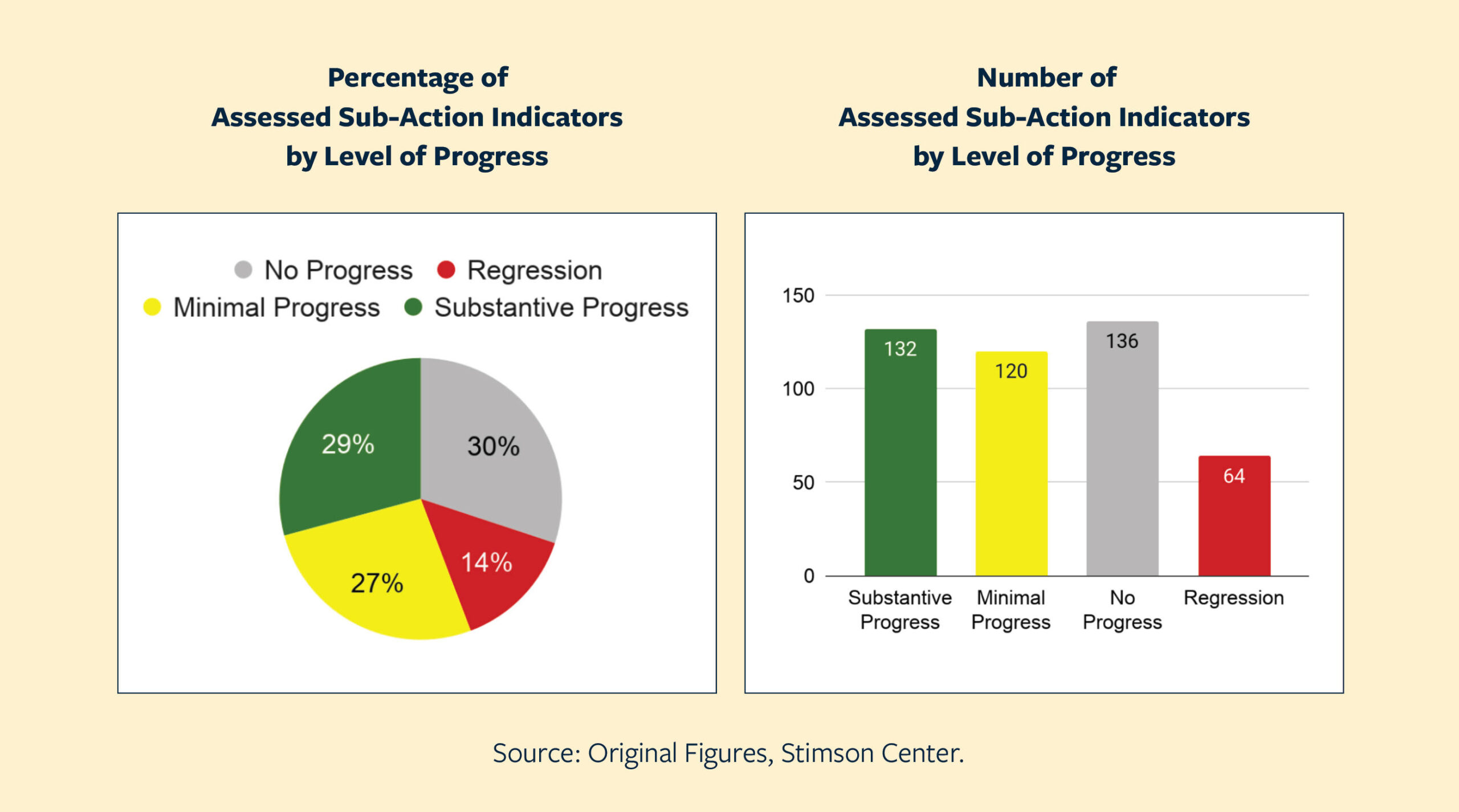
Given that initial data gaps were anticipated (with more data to evaluate progress expected in 2026 and beyond), monitoring in Year 1 has focused on a combination of process deliberations, existing official SDG indicators, and employing proxy indicators that speak to the essential meaning of a select few Pact Actions. On the whole, slow yet visible progress is observed across key elements of the Pact. For instance, steps toward strengthening the Peacebuilding Commission (Action 44) are underway through the 2025 Peacebuilding Architecture Review, and the recent (April 2025) World Bank-IMF Spring Meetings and (June-July 2025) Fourth International Conference on Financing for Development (FFD4) are helping to sustain momentum on certain international financial architecture reforms (Pact Actions 47-52). Meanwhile, and purposely gleaning insights from data trends preceding the Pact's adoption, for Action 27 Sub-Action (c) on bridging the digital divide, 68% of the world's population was online in 2024, compared to only 53% in 2019 — which could be accelerated further through the Independent International Scientific Panel on AI and Global Dialogue on AI Governance.
At the same time that initial progress is observed, proposed steep funding cuts are anticipated to hurt Pact implementation across the board, as many countries begin to pull back from foreign aid and international organization financing. It is estimated that Official Development Assistance (ODA) alone could decline by 20% to 40% in the coming years amidst geopolitical shifts, resulting in a reduction of $50 to $115 billion less aid per annum compared to 2023. Figures already point to a decline of 7.1% in ODA in 2024 compared to 2023 — the first drop after five years of growth. Calls to raise military spending in the U.S., U.K., and EU countries — which together provided 63% of all ODA flows in 2023 — could further divert funds from development. Moreover, the Trump Administration has recommended to Congress $1.7 billion in cuts for most assessed and all voluntary contributions to the UN and other international organizations, on top of another proposed $1.6 billion reduction to the UN's peacekeeping budget (where the U.S. is already $1.1 billion in arrears). UN agencies are already feeling the strain: the UN humanitarian office faces a $58 million shortfall, forcing it to cut 20% of its staff; the United Nations Children's Fund (UNICEF) anticipates a 20% budget reduction; and the UN migration agency expects a 30% funding drop — potentially impacting 6,000 jobs.
From the seventeen intergovernmental processes overseen directly by the President of the General Assembly to other international fora beyond the UN proper in New York, including the World Trade Organization in Geneva, G20/G7/BRICS+, Climate COPs managed out of Bonn, and regional organizations, creative and resourceful leadership — both individually and collectively by Member States — are fundamental to advancing the 291 (out of 361) government-led Sub-Actions in the Pact for the Future, Global Digital Compact, and Declaration on Future Generations. Initial evidence suggests (for instance, in the realm of peace and security Actions tracked in Chapters Two and Five of the Pact) that specific Sub-Actions can garner momentum when they are championed by even a small number of diverse and committed governments.
By mobilizing broad-based political support and financial resources, providing technical and research-based inputs, and shining light on both progress and setbacks, the diverse ImPact Coalitions — backstopped by the Coalition for the UN We Need and working across the Pact for the Future agenda — can buttress the central leadership role of governments and international organizations in driving meaningful changes. In particular, their contributions are recognized in the run-up to this June-July's FFD4 Conference (Actions 4, 47, 49, and 52), the 2025 UN Peacebuilding Architecture Review (Action 44), and work on advancing AI and other cybertech cooperation (Actions 27, 29, and 33, and the Global Digital Compact Objective #5).
The Pact responds to detractors of the UN and other multilateral bodies by demonstrating that: a) a broad international consensus can be reached on urgent reforms toward making the global governance system "fit-for-purpose"; and b) initial steps toward delivering on these commitments from last September's Summit of the Future are beginning to bear fruit. The Pact can serve as a proxy for those governments and non-state actors seeking to invest in multilateral approaches for global problem-solving. Rather than increasing financial burdens or expanding international bureaucracy, many Pact Actions tracked in this report (including those associated with UN 2.0 technological and foresight applications) should align well with the Secretary-General's "UN80 Initiative" to "update the UN's structure, priorities, and operations for the 21st century." Conversely, the UN80 Initiative can help to advance the ambitions of the Pact for the Future by creating a more agile, cost-effective, and impactful multilateral system.
Pact in Action

Pact in Action

(March 19, 2026)
Pact Innovation Plan (2nd Edition) Luncheon Discussion
Co-hosted by the Global Governance Innovation Network, Mission of Germany, Mission of Namibia, Mission of India, Mission of Zambia, Mission of Singapore, Mission of the United Kingdom, Mission of Croatia, Mission of Portugal, Liechtenstein Institute on Self-Determination, and Mission of Brazil.
(March 18, 2026)
Monitoring Global Governance Multilateral Agreements
Co-hosted by the Global Governance Innovation Network, The New School Graduate Programs in International Affairs, and United Nations Academic Impact.
(November 24-25, 2025 )
Pact Innovation Forum Pocantico Retreat: Planning for 2026
Co-hosted by the Global Governance Innovation Network, United Nations University Centre for Policy Research, Rockefeller Brothers Foundation, Global Challenges Foundation, and the Stimson Center.
(September 24, 2025)
UNGA@80 Pact Innovation Forum High-Level Breakfast Dialogue
Co-sponsored by the Global Governance Innovation Network, Baha'i International Community, Plataforma CIPÓ, Savannah Centre for Diplomacy, Democracy, and Development, and the Stimson Center.
(July 10, 2025)
Informal Ambassadorial Level Roundtable on a Pact Innovation Forum
Co-sponsored by the Permanent Missions of Brazil, Costa Rica, Croatia, European Union, Germany, India, Jamaica, Japan, Namibia, Netherlands, Nigeria, Portugal, Singapore, South Africa, Switzerland, United Kingdom, Zambia.
(May 19, 2025)
Informal Interactive Dialogue 2: The Pact for the Future – Monitoring and Evaluation | General Assembly, 79th session
Hosted by the United Nations President of the General Assembly Summary.
(March 20 - April 30, 2025)
Pact Innovation E-Consultation
Co-moderated by the Global Governance Innovation Network, Coalition for the UN We Need, Project Starling, Oxfam International, Pathfinders (NYU CIC), Plataforma CIPÓ, Baha'i International Community, Academic Council on the UN System, Institute for Economics and Peace, UN University Center for Policy Research, and the Stimson Center.
(February 27, 2025)
Pact Innovation Plan Informal Roundtable
Co-sponsored by sixteen UN Missions, including the Permanent Missions of Australia, Brazil, Croatia, Germany, Jamaica, Japan, Morocco, Namibia, Netherlands, Nigeria, Portugal, Singapore, South Africa, Switzerland, United Kingdom, and Zambia to the United Nations, and the Global Governance Innovation Network.
(November 24-26, 2024)
Summit of the Future Follow-Through Retreat at the Pocantico Center
Co-hosted by the Global Governance Innovation Network, Rockefeller Brothers Foundation, Global Challenges Foundation, and the Stimson Center
(September 26, 2024)
Taking the Summit of the Future Agenda Forward: UNGA Roundtable on Facilitating Implementation through Dialogue, Research & Monitoring
Co-sponsored by the Global Governance Innovation Network, Savannah Center for Diplomacy, Democracy and Development, Plataforma CIPÓ, Global Challenges Foundation, Kingdom of the Netherlands, and the Stimson Center
Scroll to Top