


Home > Library > Library Entry: Policy Solutions
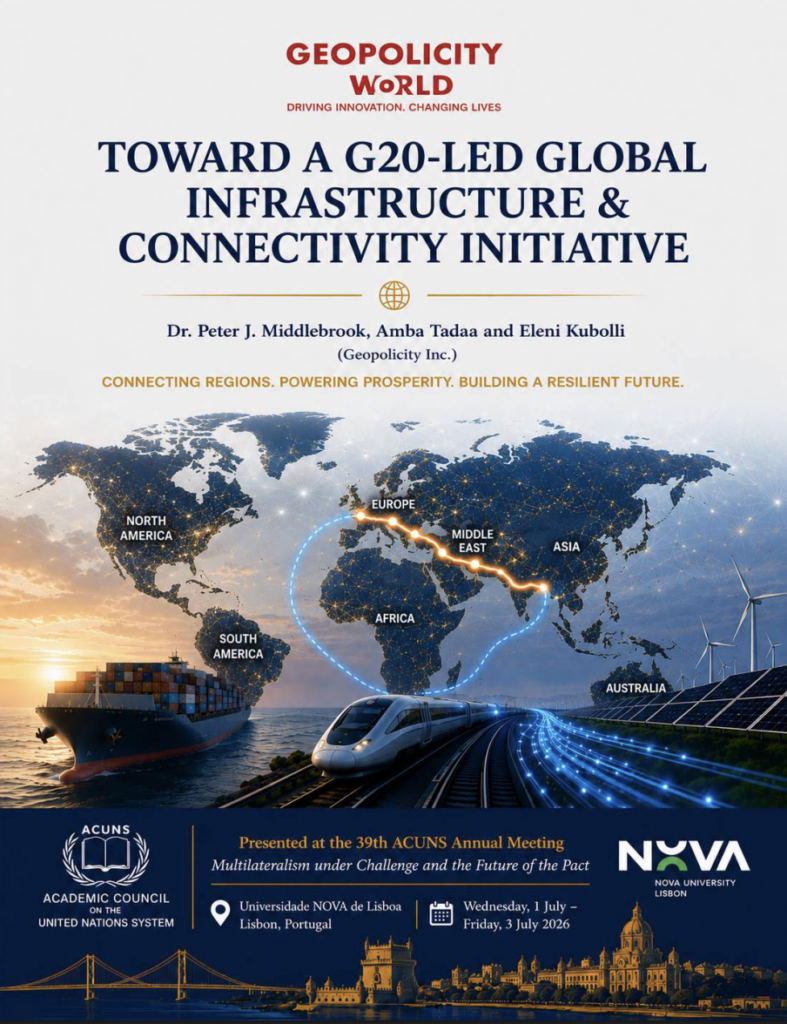
Toward a G20-Led Global Infrastructure & Connectivity Initiative
Library Entry Details
This Library includes publication entries by GGIN Partner institutions which are collected in the interest of promoting research and sharing knowledge. Library entries are subject to the academic integrity policies and review processes of the contributing institution. Unless otherwise noted, they are not publications of the Stimson Center, the Global Governance Information Network project, or any other partner institution.
Publication Type
Contributing Institution
Availability
Posted
Authorship
Abstract
Commissioned for the T20 U.S. in 2026, this study examines whether connectivity can remain a domain of practical multilateral cooperation in an increasingly fragmented and multipolar international system. As geopolitical competition, economic nationalism, supply-chain restructuring, and rival infrastructure initiatives reshape the global economy, connectivity has become both a driver of development and an instrument of strategic influence. The paper argues that the central challenge facing the international community is no longer simply the absence of infrastructure initiatives, financing mechanisms, or technical standards, but the growing fragmentation of the global connectivity landscape itself. Competing platforms and corridors, are increasingly developing within separate geopolitical, institutional, and financial spheres. This creates risks of duplication, incompatible standards, regulatory divergence, inefficient capital allocation, and reduced development gains for countries seeking access to multiple markets and partners.
Using the India–Middle East–Europe Economic Corridor (IMEC) as a case study, the paper illustrates
both the promise of cross-regional, multi-domain connectivity and the governance gaps that can
undermine corridor-based cooperation in a contested international environment. The paper argues that
while the G20 cannot govern global connectivity directly, its contribution lies not in building or financing
infrastructure, but in reducing fragmentation by promoting dialogue, interoperability, transparency,
evidence-sharing, and coordination across competing systems.
The G20 remains one of the few forums capable of convening advanced economies, emerging powers,
major infrastructure financiers, multilateral development banks, and key regional actors within a
common framework. As such, the paper concludes by proposing a G20 Connectivity Compact as a
voluntary mechanism for advancing practical cooperation across the emerging global connectivity
landscape.
Full Text
Downloads
Geography
topics
Stay Informed
Receive email updates about the Global Governance Innovation Network and related research.
You can opt out at any time. Read our privacy policy.