Co-Sponsors: Global Governance Innovation Network, Academic Council on the UN System, Stimson Center, Global Challenges Foundation, United Nations University Center for Policy Research, Leiden University, Plataforma CIPÓ, Global Institute for Strategic Research, Council on Energy, Environment & Water, Savannah Centre for Diplomacy, Democracy & Development
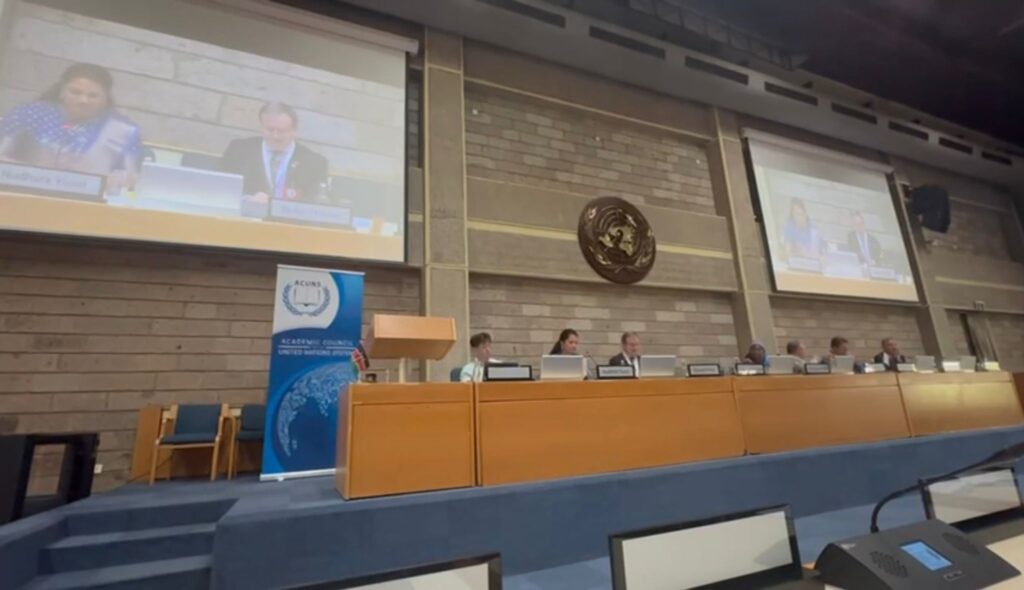
The 2025 Academic Council on the UN System Annual Meeting on "Environmental Multilateralism and Human Development," held from 23–25 June 2025 at the University of Nairobi and United Nations Office in Nairobi, featured three Global Policy Dialogue (GPD) sessions and a concluding plenary focused on the theme of "The Triple Planetary Crisis (Climate Change, Biodiversity Loss, and Pollution) and Future of Environmental Governance." These sessions were convened with the following objectives:
To expand the knowledge base for more capable global institutions to better cope with existing and emerging environmental challenges and to create new opportunities through effective global action, including with scholars, policy researchers and advocates, and the private sector.
To convene leading policy researchers, practitioners, and advocates to debate and recommend specific global institutional, policy, legal, normative, and operational innovations that could follow through the agenda of the Pact for the Future, adopted by the United Nations Summit of the Future in September 2024.
To make targeted recommendations for mobilizing support and operationalizing global environmental commitments—including the Paris Climate Agreement, the Convention on Biological Diversity, the 2030 Agenda, and others—in a shifting geopolitical climate.
The GPD sessions were organized into three thematic discussions (i. Global Governance of Climate; ii. Global Governance of Biodiversity and Nature; and iii. Global Governance of Pollution and Waste) and explored the following questions:
What are the structural drivers of the triple planetary crisis, and what political, legal, and institutional obstacles impede multilateral solutions?
How can normative, policy, institutional, operational, and legal reforms overcome these barriers to enable effective action?
How can GPD partners extend the COP 30 and Summit of the Future research agendas to produce innovative initiatives that mitigate climate change, biodiversity loss, and pollution at scale?
Downloads
This item has no attachments.
Geography
topics
Stay Informed
Receive email updates about the Global Governance Innovation Network and related research.
We use cookies to measure website traffic (Google Analytics) and make the website work (User logins). We do not sell your information.
Necessary
Always active
The technical storage or access is strictly necessary for the legitimate purpose of enabling the use of a specific service explicitly requested by the subscriber or user, or for the sole purpose of carrying out the transmission of a communication over an electronic communications network.
Preferences
The technical storage or access is necessary for the legitimate purpose of storing preferences that are not requested by the subscriber or user.
Statistics
The technical storage or access that is used exclusively for statistical purposes.The technical storage or access that is used exclusively for anonymous statistical purposes. Without a subpoena, voluntary compliance on the part of your Internet Service Provider, or additional records from a third party, information stored or retrieved for this purpose alone cannot usually be used to identify you.
Marketing
The technical storage or access is required to create user profiles to send advertising, or to track the user on a website or across several websites for similar marketing purposes.