


Home > Updates > Dialogue Summary
Author

GGIN at Doha Forum 2024

Contributed by Doha Forum, Global Governance Innovation Network, Global Institute for Strategic Research, Hamad Bin Khalifa University, Stimson Center
Posted 16 December 2024
At Doha Forum 2024, on the theme of“The Innovation Imperative,” GGIN and its partners hosted and spoke at events on harnessing AI and other technologies for peace and development through global and regional governance innovations (building on the Future of International Cooperation Report 2024). On 6 December 2024, the Hamad Bin Khalifa University College of Public Policy (HBKU-CPP), Stimson Center, and Global Governance Innovation Network hosted, at HBKU-CPP, a Global Policy Dialogue on MENA Perspectives on Global and Regional Governance in Turbulent Times and initiated steps toward a new Arab research network focused on regional and global governance innovation. Stay tuned for further details on both in early 2025! Visit the forum's website for more details and highlights.
The Innovation Imperative: Governing Technology for Global Development

What institutions and practices – globally, regionally, and nationally – are required to harness technology's full potential for the benefit of all of humanity? Drawing on the findings and policy recommendations from the second edition of the Future of International Cooperation Report 2024 (FIC'24), this expert roundtable, hosted in partnership with Global Institute for Strategic Research, gave special consideration to how technology and its governance can best advance and safeguard fundamental development goals, including the 2030 Agenda for Sustainable Development and the agenda now under preparation for the Second World Summit on Social Development planned for 2025. Specifically, the session examined both the risks and promise of technology governance innovations for global development in the AI/cyber-tech, biotech, and green-tech spaces. Bringing together seasoned policymakers, policy researchers, and policy advocates, the session will sought to aspire Doha Forum participants on the state-of-the-art, in terms of both thinking and practice for using technology as a force for good rather than ill.
Speakers
- Dr. Maryam Al-Khater: Professor, Qatar University
- Prof. Hassan Aly: Dean of Economics and Public Policy, Nile University
- Dr. Pedro Conceição: Director of the Human Development Report Office, United Nations Development Programme (UNDP)
- H.E. María Fernanda Espinosa Garcés: Former President of the UN General Assembly, Executive Director of GWL Voices for Change and Inclusion
- Tassadit Gharbi: President and CEO, Al Fahd Consulting and Technology LLC
- Tomas Lamanauskas: Deputy Secretary-General, International Telecommunication Union
- Dr. Michal Mlynar: UN Assistant Secretary-General and Deputy Executive Director, UN Habitat
- Wafic Naccash: Government Affairs Lead, Microsoft
- Dr. Paul Porteous: Director, Centre for Social Leadership
- Ala Qasem: CEO, DeepRoot Consulting
- Jeevan Thiagarajah: Chairman, Centre for Humanitarian Affairs
- Nudhara Yusuf: Executive Coordination Global Governance Innovation Network, Stimson Center
- H.E. Madiyev Zhaslan: Minister of Digital Development, Innovation and Aerospace Industry, The Republic of Kazakhstan
- Dr. Maha Yahya: Director, Malcom H. Kerr Carnegie Middle East Center
- Prof. Karim Makdisi: Associate Professor of International Politics, American University of Beirut
- Nesreen Barakat: CEO, Jordan Strategy Forum (Moderator)
The Innovation Imperative: Governing Technology for Global Peace & Security
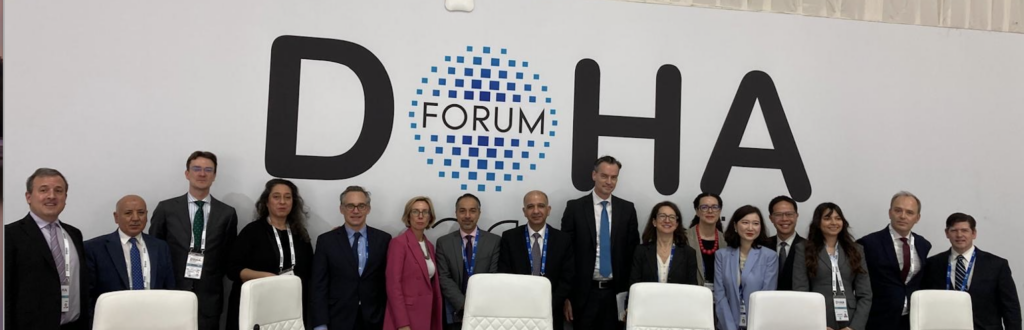
What institutions and practices – globally, regionally, and nationally – are required to harness technology's full potential for the benefit of all of humanity? Drawing on the findings and policy recommendations from the second edition of the Future of International Cooperation Report 2024 (FIC'24), this expert roundtable gave special consideration to how technology and its governance can best advance and safeguard fundamental security goals and the quest for sustainable peace. Specifically, the session sought to examine both the risks and promise of technology governance innovations for global peace and security in the domains of AI/cyber-tech, weapons of mass destruction, and minerals for military applications. Bringing together seasoned policy-makers, policy researchers, and policy advocates, the session sought to inspire Doha Forum participants on the state-of-the-art, in terms of both thinking and practice for using technology as a force for good rather than ill.
Speakers
- Dr. Renata Dwan: Special Adviser, United Nations Office of the Secretary Generals Envoy on Technology
- Dr. Guma El-Gamaty: Party Leader, Taghyeer Political Party
- Dr. Ammar Kahf: Executive Director, Omran Center for Strategic Studies
- Dr. Joris Larik: Assistant Professor and Senior Advisor, Leiden University and Stimson Center
- Dr. Richard Ponzio: Director, Global Governance, Justice & Security Program, Stimson Center
- Brigadier General Ng Pak Shun: Brigadier General & Group Chief, Policy & Strategy and Group Chief, Plans & Transformation , Ministry of Defense of Singapore
- Mona Khalil: President and CEO, MAK Law International
- Muznah Siddiqui: Global Governance Associate, United Nations University Center for Policy Research
- Brian Finlay: President and CEO, Stimson Center (Moderator)
Global Policy Dialogue: MENA Perspectives on Global and Regional Governance in Turbulent Times
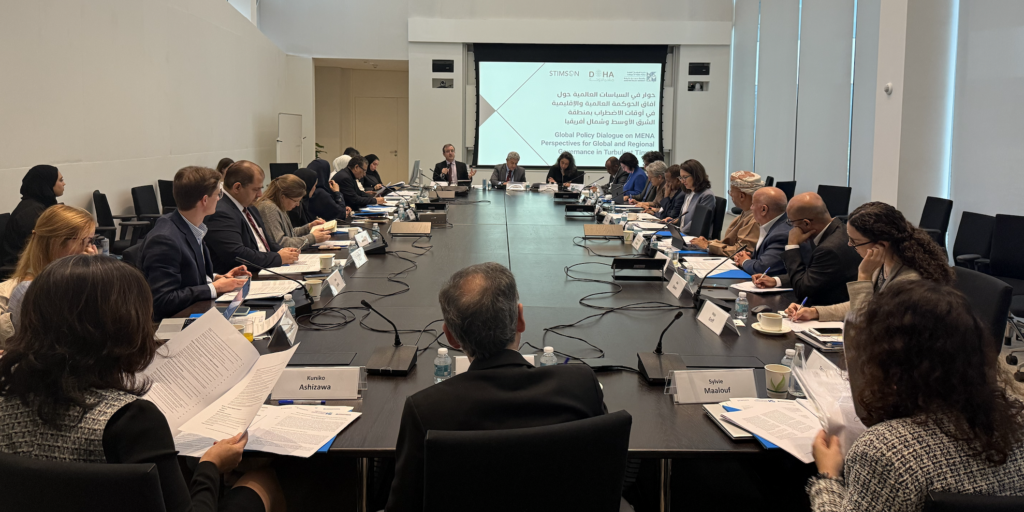
Co-organized by the College of Public Policy at Hamad Bin Khalifa University and Stimson Center, in partnership with the Doha Forum and Global Governance Innovation Network, the Global Policy Dialogue on Middle East and North Africa Perspectives on Global and Regional Governance during Turbulent Times (MENA GPD) was held on 6 December at Hamad Bin Khalifa University in Doha. It explored, with leading experts and policy-makers from the MENA region and beyond, ways to innovate and strengthen the policy and operational interplay between the United Nations system (including the international financial institutions), World Trade Organization, G20, the Arab League, Organization of Islamic Cooperation, Gulf Cooperation Council, the Arab Maghreb Union, and the Community of Sahel-Saharan States. Held in conjunction with the 7-8 December 2024 Doha Forum, this Track 1.5 Policy Dialogue began a discussion to stand-up a new Arab research network focused on regional and global governance innovation. It further built-upon and advanced within the MENA regional context recent (22-23 September 2024) Summit of the Future agreements, namely the Pact for the Future, the Global Digital Compact, the Declaration on Future Generations, and the Agenda for Peace. A brief outcome report will be made available on the Global Governance Innovation Network website in the new year.
Downloads
Author
Geography
topics
Stay Informed
Receive email updates about the Global Governance Innovation Network and related research.
You can opt out at any time. Read our privacy policy.